Kinet
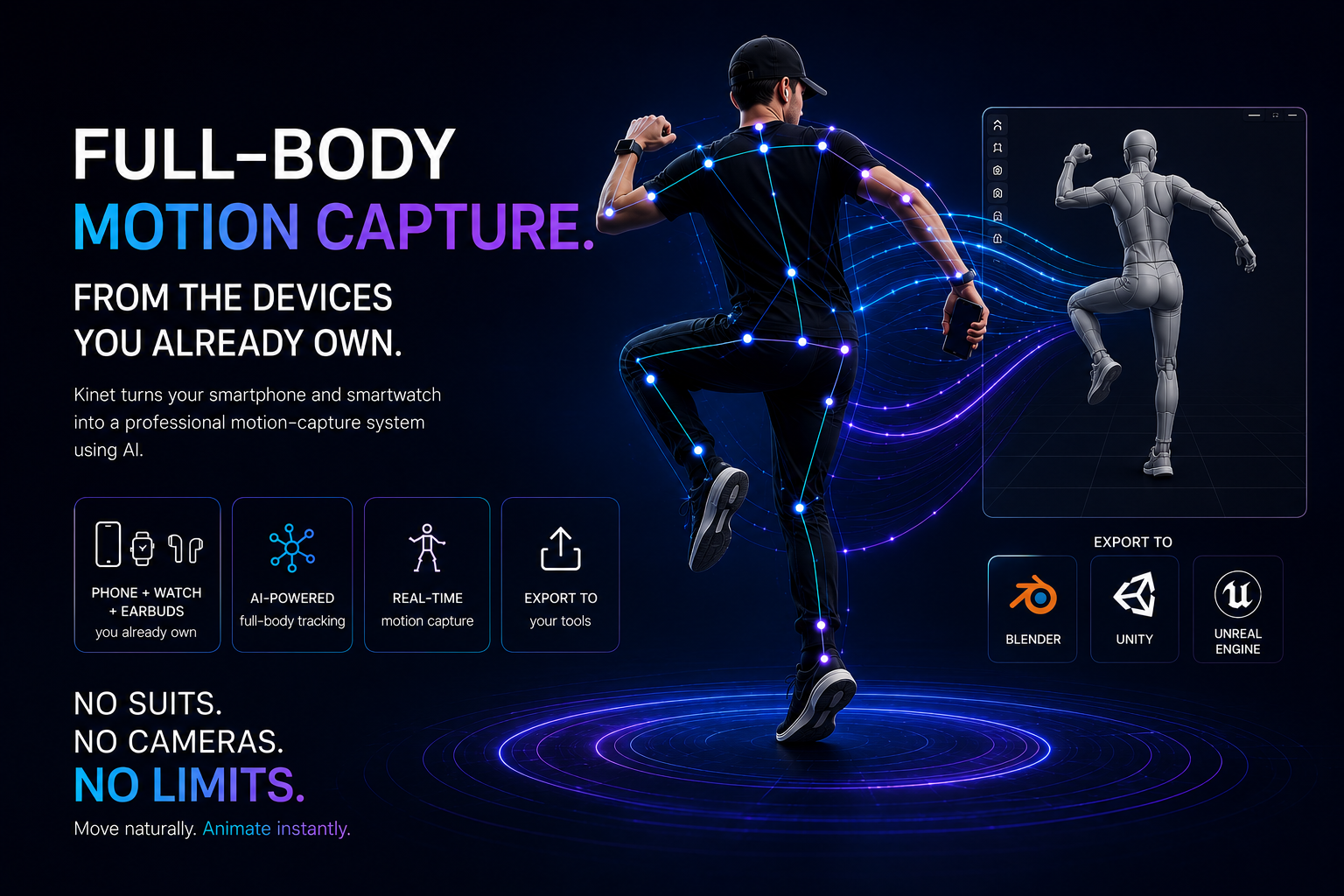
Professional motion capture, free, from the phone, watch and earbuds you already own, exported straight into Blender, Unity, and Unreal.
Summary
Kinet turns the smartphone, smartwatch and earbuds people already own into a full-body motion-capture rig. Professional mocap normally costs €2,500–€10,000 in hardware or an expensive camera studio, locking out millions of indie game developers, VTubers, and 3D creators who then animate by hand for hours. Kinet uses the motion sensors already in everyday devices, plus AI, to reconstruct full-body movement in real time with no special hardware, no cameras, no markers and exports it straight into the tools creators already use. The same engine extends into tele-rehabilitation and sports analytics. Working prototype built solo; won the LaunchX competition and a Slush ticket.
Problem
Motion capture is how realistic 3D character animation gets made, but it's locked behind cost and complexity. Sensor suits cost €2,500–€10,000+, camera studios are expensive and fixed-location, and markerless video needs good cameras and setup. So indie creators are either priced out of the hardware or burned out hand-keyframing every movement for hours. There's no affordable middle ground.
Solution
Kinet captures full-body motion from just two devices people already own, a phone in the pocket and a watch (or second phone) on the wrist. Sparse inertial sensors stream to an AI pose model that reconstructs the full body in real time, with automatic calibration and zero setup. The result exports as standard mocap files (BVH/FBX) directly into Blender, Unity, and Unreal, fitting creators' existing workflows instead of replacing them.
Market
The 3D motion-capture market is ~$340M (2025), projected to ~$1.03B by 2034, with wearable/markerless capture the fastest-growing segment. Beachhead: millions of indie game developers, VTubers, and 3D creators already on Unity, Unreal, and Blender, community-driven, and underserved by costly or complex existing tools. The same pose engine expands into tele-rehabilitation and sports/fitness analytics, each a multi-billion-dollar market.
Customers & users
Target users: indie game developers, VTubers, and independent 3D animators. Future Targets: Healthcare services, sport analytics teams
Competitive advantage
Zero extra hardware. The "rig" is devices the user already owns, so distribution is software-only and capture happens anywhere over WiFi. Output drops into the tools creators already use. The moat is productization and execution (live multi-device sync, auto-calibration, real-time pipeline, export/retargeting) plus a future consent-based motion-data flywheel. One engine amortized across creator, rehab, and sports verticals.
Traction
Won the LaunchX pitch competition and earned a Slush ticket. Built a working end-to-end prototype solo in days: Live two-device capture, real-time avatar, and BVH/FBX export into Blender. In early conversations with an investor (post-LaunchX) pending customer validation. Customer-validation sprint underway (waitlist + creator interviews).
Competitors
Pitch deck
Pitch deck will be visible when you log in.
Sign up / Sign in